
Article originally appeared in Able SC’s September 2026 Youth Team Newsletter, produced by Able SC’s Youth Team.
Interview with a Writer with a Disability
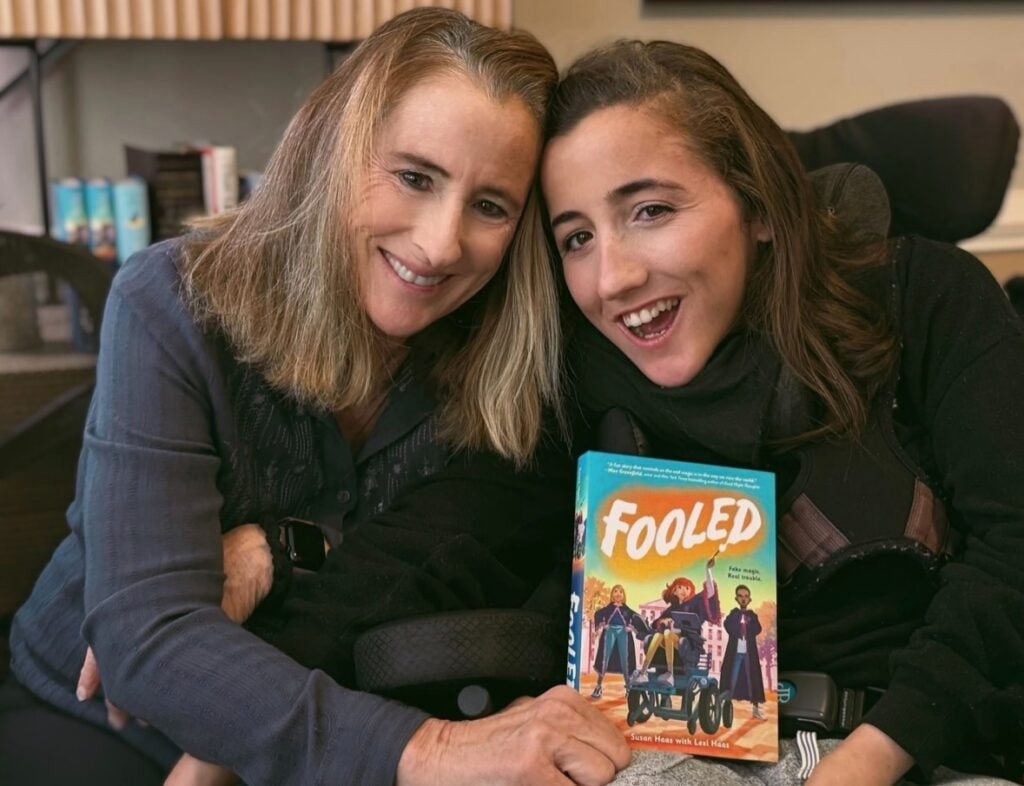
[ID: A headshot of Lexi Haas, a young woman in a wheelchair with long brown hair and a black shirt. She is sitting next to her mother, Susan Haas, a middle-aged woman with short gray hair, wearing a bluish gray shirt. Susan is holding up a copy of their book, “Fooled,” in front of Lexi. They are both smiling at the camera.]
Able SC’s youth team sat down with Lexi Haas, a nonspeaking author with physical disabilities. Lexi co-writes with her mom, Susan Haas, and has written two middle-grade novels. “The Year of the Buttered Cat” is a memoir about growing up with a disability, and “Fooled” is a fictional novel about a group of students with disabilities who convince their nondisabled peers that they have magical powers. Read the interview below.
Interviewer: What is your writing process like?
Lexi: “My mom and I write together. We go back and forth at first to come up with ideas together. That’s my favorite part. We fill an entire notebook before we start writing the story. After that, Mom writes out the story we developed together, then we go back and forth to fill in the missing pieces.”
Interviewer: Why do you think disability representation in media is important?
Lexi: “I think it’s important for everyone to be able to see themselves in books and movies. It means so much to see that our stories are worth reading about.”
Interviewer: What are some of the best parts of being a writer with a disability, and what are some challenges you face?
Lexi: “The best part is that I get to bring my experiences and perspective to life. I can write characters that I wish I had seen when I was growing up. As far as challenges go, everything takes a long time. It took us about five years to write our first book. It’s gotten faster, but it’s still slow. Thanks to my severe dystonia, I basically wake up with a different body every day. I never know what communication avenue is going to work, so I have to have not just a plan B for when my preferred aug com [augmented communication] isn’t working for me, but plans C-Z, too!”
Interviewer: What advice do you have for young people with disabilities who want to be writers?
Lexi: “First and foremost, don’t undersell your disability experience. We tend to think it’s ordinary, but for most people every little thing we experience is an eye-opener. Be sure that unique perspective makes it onto your pages. Second, practice! Write anything and everything to keep your creativity flowing. 99% of what I write never winds up in a book, but every word has a place in the process. Don’t pressure yourself with the idea that your content has to be spectacular right out of the gate. Mine isn’t!”